Fact check · Misleading
Bradford says families are "counting the minutes" waiting for 911. That wait was cut in half two years ago.
Four posts in a week built the case for hiring 1,000 police officers. The staffing numbers underneath are broadly right. Almost everything built on top of them falls down: the 911 claim, the chart, the missing price tag.
Families deserve to know they won't be counting the minutes after calling 911. Seniors deserve to feel safe taking transit. That's why I'm committing to hiring 1,000 new front-line police officers to strengthen neighbourhood policing, support officers who are being asked to do more, and help Toronto catch up with other major cities. The status quo isn't enough. Let's build a city we can be proud of: https://bradford26.ca/sign-up
His numbers are right. His story isn’t.
Between 20 and 26 July, Bradford made one argument across four posts: Toronto’s police are dangerously understaffed, the current administration has done nothing, and 1,000 new officers are the fix.
The numbers underneath are real. Toronto has the lowest officers-per-resident ratio of any large Canadian city, about 163 per 100,000 in 2023 and roughly 171 now. The population has grown by about 600,000 since 2010 on a nearly flat headcount. He even concedes, once, that cop-to-pop is “an imperfect metric.”
Everything he builds on those numbers points where the evidence doesn’t.
The 911 wait he invokes was cut in half two years ago
The pledge opens: “Families deserve to know they won’t be counting the minutes after calling 911.”
That described 2023. Priority 1 response, the most urgent calls, has since collapsed:
| October 2023 | 26.7 minutes, the peak |
| Early 2024 | 19.6 minutes |
| March 2025 | 12.6 minutes, then at or below ~13 for four straight months |
A 12.6-minute wait is not nothing, and “our response times should be better” would stand. But the claim is deployed as the reason to change course, and the “status quo” he says isn’t enough is exactly what halved the number, on the flat headcount he calls the problem.
The ratio got worse. The service got better. His posts carry only the first half.
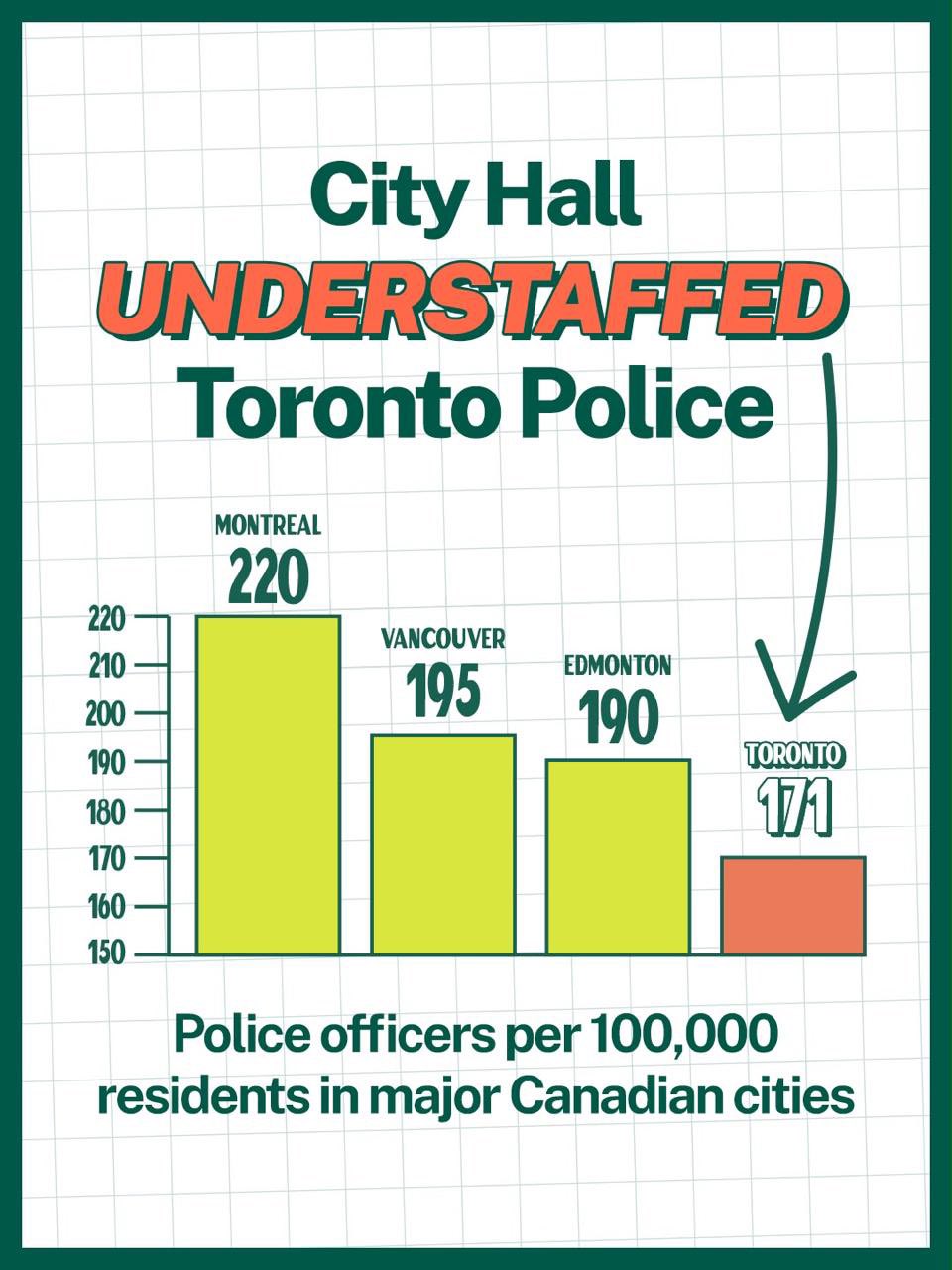
His chart turns 78% of Montreal’s rate into 30%
The pledge graphic, headed “City Hall UNDERSTAFFED Toronto Police,” compares four cities using real figures. Then it starts its axis at 150 instead of zero, cutting the bottom 150 units off every bar and roughly tripling the visible differences.
| Montreal | Vancouver | Edmonton | Toronto | |
|---|---|---|---|---|
| Figure shown | 220 | 195 | 190 | 171 |
| Bar as drawn, vs Montreal | 100% | 64% | 57% | 30% |
| Actual share of Montreal’s rate | 100% | 89% | 86% | 78% |
Toronto staffs at 78% of Montreal’s rate. The chart shows a third. This is the one element of the campaign that can’t be read as emphasis or omission: correct numbers, drawn to misstate their relationship.
The fix he skips is one he voted for
Toronto didn’t halve its 911 waits by hiring. It mostly stopped sending police to calls that never needed them.
The Toronto Community Crisis Service, now the city’s fourth emergency service, resolved 78% of its calls with no officer involved at all (March 2022 to December 2024, with 2025 projected near 84%), on 2 to 3% of the police budget.
| Cost | Delivers | |
|---|---|---|
| 143 net new officers (2026 budget) | $20.5M/year | ≈$143,000 per officer, recurring |
| Toronto Community Crisis Service | ≈2 to 3% of the police budget | 78% of its calls closed with no officer dispatched |
Diversion has a ceiling, since it can’t absorb violent crime or run investigations, but nobody has shown Toronto is at it, and city staff have recommended expanding it further.
And in October 2025, council voted 23-1 to extend the service to the TTC. Bradford voted yes. Nine months later: four posts on police capacity, no mention of the cheaper lever he helped expand.
$143 million a year to overshoot a range the current plan already meets
Bradford hasn’t costed the pledge. His campaign will “roll those numbers out later in the campaign.”
The city’s budget does it for him. At the 2026 rate of $20.5 million for 143 net new officers, about $143,000 each and recurring, 1,000 officers runs on the order of $143 million a year, permanently. That is consistent with Councillor Shelley Carroll’s estimate of over $100 million.
Two harder problems sit underneath:
- The pledge outruns the training pipeline. Netting 1,000 officers in a four-year term means recruiting at least ~470 a year once separations (~217 and rising, per TPS’s own projections) are replaced. The police college caps at roughly 360 a year, and the plan he calls insufficient already uses all of it. Read as promised, on top of the existing plan, the arithmetic needs ~610 a year.
- The spending buys an overshoot. Toronto’s defensible staffing band, worked back from service levels, is roughly 170 to 185 per 100,000. The existing plan reaches ~172 by 2029, inside the band. His 1,000 puts Toronto near 200: Montreal’s rate, without Montreal’s crime.
The file isn’t closed. Holding 172 as the city grows takes continued hiring, and 12.6 minutes was a good-season reading. But that is what the existing plan already does. What the extra $143 million a year buys, on the city’s own numbers, is staffing past the range the service data supports, through a college that cannot train the officers on the schedule promised, while the lever that actually cut response times runs on 2 to 3% of the police budget.
The peer cities are doing different jobs
London’s 375 officers per 100,000 includes national counter-terrorism command, royalty and diplomatic protection, and national fraud policing. New York’s 414 counts roughly 5,000 school safety agents and 4,000 traffic agents. Toronto shares rail, cyber, terrorism and border work with federal and provincial agencies and counts none of it.
Divide by crime instead of population and the ranking flips: roughly 55 officers per 1,000 Criminal Code incidents in Toronto, against about 44 in Montreal and 25 in Vancouver. One caveat cuts back. Understaffed forces record less crime, so treat that as an upper bound. The direction is still clear: Toronto’s low cop-to-pop mostly reflects low crime.
His strongest argument is the one with no numbers
The announcement video argues something the response-time recovery can’t answer: burnout. Double shifts, “answering the calls alone that used to get two cars,” officers trained in Toronto and lost “to forces that aren’t running on empty.”
That case is real. A service can hit its emergency targets on overtime and single-officer dispatch and still be unsustainable. It is also the only claim of the week he offers no evidence for: no attrition breakdown, no dispatch data, no overtime totals.
We checked the public data separately, and it points elsewhere. The police service attributes its attrition to retirement rather than rival forces. Rated Unsubstantiated.
The Chow claim got its own rating too
“Every chance Mayor Chow has had to take action on public safety, she’s decided not to”, posted four days before the pledge, is contradicted by the record, including a safety motion Bradford himself moved that Chow voted for. Rated False.
The ruling
The staffing figures are accurate, and one post hedges the metric. That is the strongest thing that can be said for the week.
Everything assembled on top points the other way. The 911 wait he invokes was halved under the plan he calls inadequate. The chart triples the gap it claims to illustrate. The diversion lever that did much of the work, one he voted to expand, never comes up.
And the money points the same way: $143 million a year, recurring and uncosted by his campaign, to overshoot the staffing range the service data supports, through a training pipeline already running at capacity.
Not false numbers. True numbers arranged, and in one case drawn, to support a conclusion they don’t support on inspection.
Misleading.
The other posts, archived
Four days earlier, on Chow's record
Every chance Mayor Chow has had to take action on public safety, she's decided not to. She's made her peace with the status quo. I haven't.
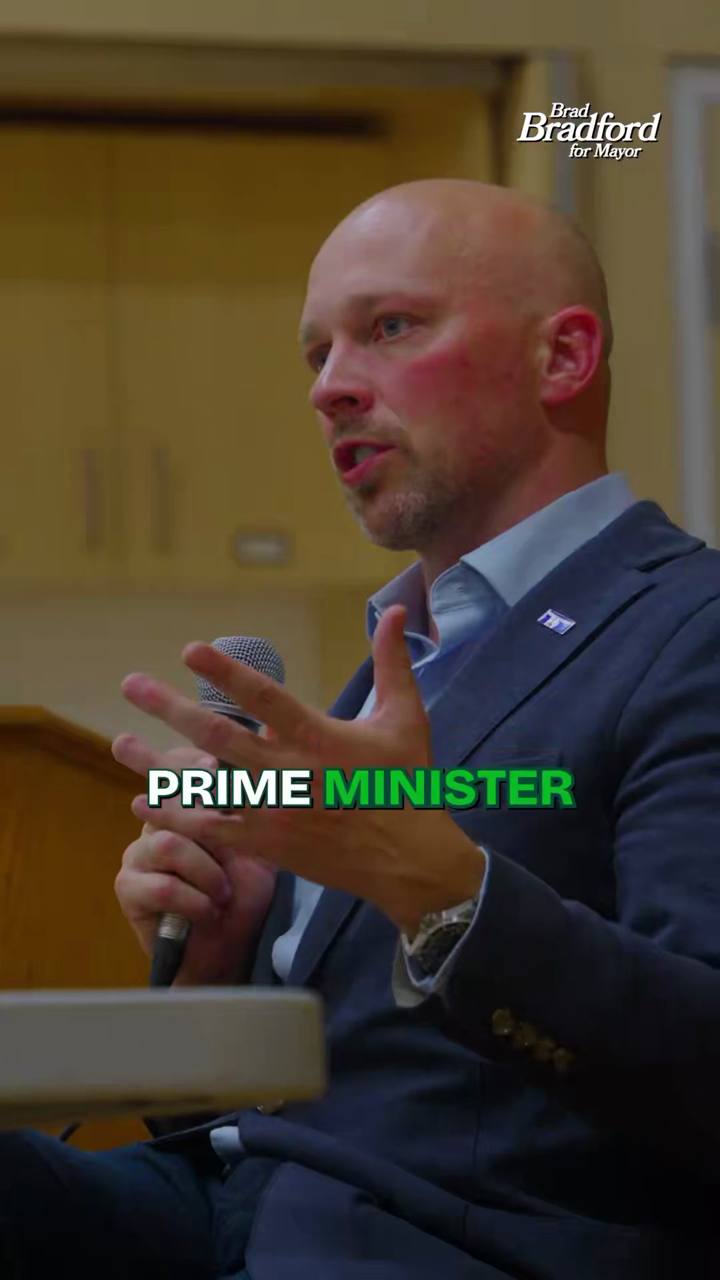
Transcript, from Whisper transcription of the clip's audio, condensed
I'll tell you a story. Prime Minister Carney was elected, and it's customary for the new Prime Minister to sit down with the Mayor of Toronto, because it's the largest city in the country, and they talk about shared priorities. Now, let's remember, the current PM was elected on bail reform, was elected on dealing with organized crime, was elected on auto theft. Two years later, we're having this meeting because we have those issues. [...] Mayor Chow penned a four-page letter to the Prime Minister outlining her priorities. In four pages, there was not a single sentence about bail reform, bail compliance, auto theft, organized crime, community safety.
The announcement itself, the day before the pledge post
A safe city isn't built by asking people to do more with less. My plan will hire 1,000 more police officers to serve our communities and back up existing officers.
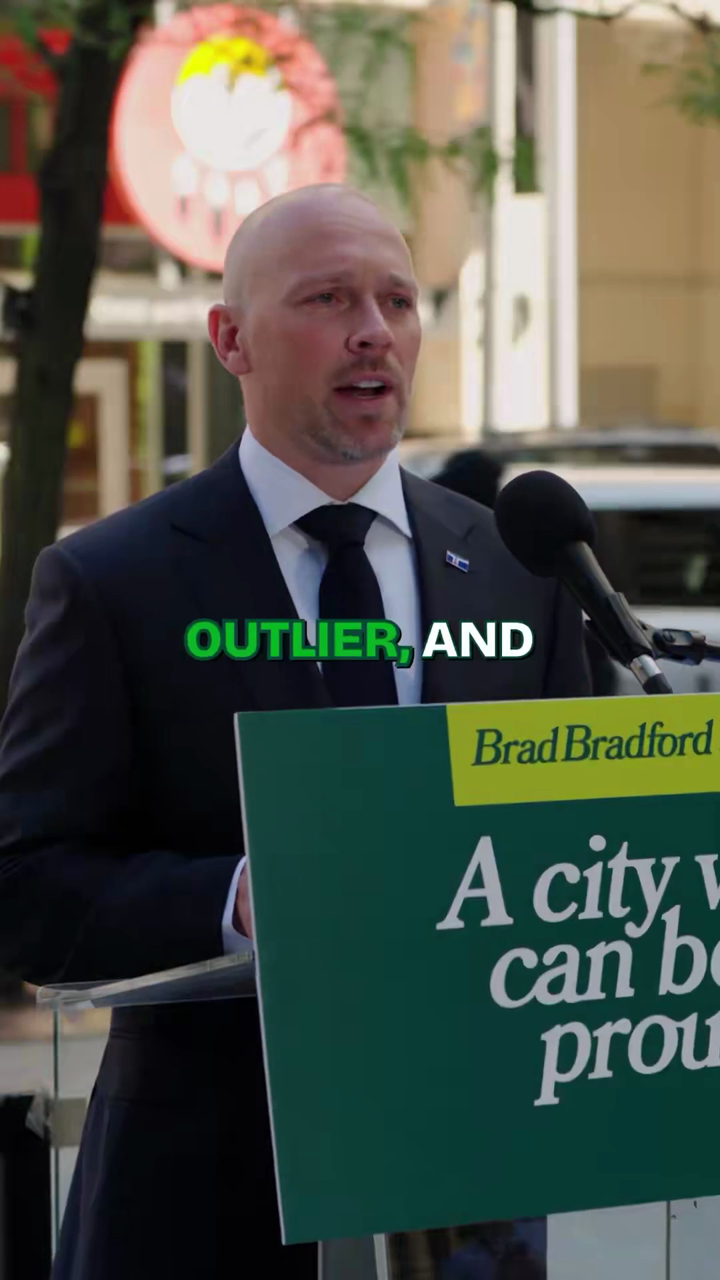
Transcript, from Whisper transcription of the clip's audio
What I'm proposing is not radical. This isn't an experiment. It's simply catching up to the country that we already live in. Toronto is an outlier and residents are paying for it. A thousand new officers will help ensure our police service has the resources it needs to keep our streets safe, our festivals, our transit, and our neighbourhoods safe. Because when a police service is stretched thin, the officers are stretched thin too. They're the ones working the double shifts, the relentless callbacks. They're the ones answering the calls alone that used to get two cars. They're the ones burning out and burning through their families to cover a staffing gap that they didn't create. It's more calls. It's longer nights. It's less backup. That's not a policing problem. That's a math problem. A thousand more officers means more backup arrives faster when you call for it. It means shifts that let officers go home to their families. It gives officers time to get to know the neighbourhood [...] walking it on foot instead of racing from call to call in a car. And it means that the best people stay here with the Toronto Police Service, because right now we train officers and then we lose them to forces that aren't running on empty. None of this is complicated. More officers on the street protecting more people in every neighbourhood. On October 26th, this city will have a choice.
Two days after the pledge, making the ratio argument directly
A big investment in Toronto's police is what this city needs.

Transcript, from the clip's burned-in captions, which reproduce his verbal stumbles, and corroborated against a Whisper transcription of the audio
And I— I think one of the things that we're grappling with right now is, even at the end of Mayor Chow's hiring plan, we're only gonna have three hundred more officers than we had in twenty-ten. And the city's population has grown by— by half a million plus since then. And that's why that ratio — it's, and you know, and I appreciate it's imperfect metric, the cop-to-pop, or number of frontline officers per 100,000 residents — you know, we lag behind other major, major jurisdictions here in the city. So it— it is a big investment, but it is one that is needed.
Sources
- Post by @BradMBradford, 24 July 2026 (pledge and staffing chart)
- Post by @BradMBradford, 20 July 2026 (on Mayor Chow's record)
- Post by @BradMBradford, 26 July 2026 (NEWSTALK 1010 clip)
- Brad Bradford Pledges 1,000 New Police Officers
- Brad Bradford vows to hire 1,000 police officers over 4 years if elected
- Toronto mayoral hopeful pitches hiring 1,000 new police officers
- Remarks to the Toronto Police Service Board, Chief Myron Demkiw, 4 March 2025
- Toronto police responding to 911 calls 7 minutes faster than a year ago
- Response Times Decreasing
- Members of Toronto City Council Voting Record (member-voting-record-2022-2026)
- BudgetTO 2026 Budget Notes: Toronto Police Service
- Toronto Police Service 2026 Budget Requests, Board Meeting 10 December 2025
- Toronto Police Service Board Approves 2026 Operational Budget
- Toronto City Council receives Toronto Community Crisis Service mid-year progress report
- Toronto should expand non-police crisis response service across city, staff recommend in new report
- Benchmarking police numbers in London against other global cities
- Police-reported crime statistics in Canada, 2023